
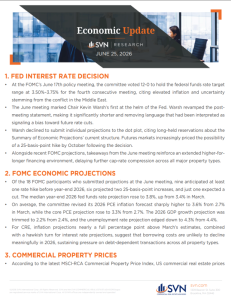
National Economic Update by SVN Research on the latest market and economic trends impacting commercial real estate.
1. FED INTEREST RATE DECISION
- At the FOMC’s June 17th policy meeting, the committee voted 12-0 to hold the federal funds rate target range at 3.50%–3.75% for the fourth consecutive meeting, citing elevated inflation and uncertainty stemming from the conflict in the Middle East.
- The June meeting marked Chair Kevin Warsh’s first at the helm of the Fed. Warsh revamped the postmeeting statement, making it significantly shorter and removing language that had been interpreted as signaling a bias toward future rate cuts.
- Warsh declined to submit individual projections to the dot plot, citing long-held reservations about the Summary of Economic Projections’ current structure. Futures markets increasingly priced the possibility of a 25-basis-point hike by October following the decision.
- Alongside recent FOMC projections, takeaways from the June meeting reinforce an extended higher-forlonger financing environment, delaying further cap-rate compression across all major property types.
2. FOMC ECONOMIC PROJECTIONS
- Of the 18 FOMC participants who submitted projections at the June meeting, nine anticipated at least one rate hike before year-end 2026, six projected two 25-basis-point increases, and just one expected a cut. The median year-end 2026 fed funds rate projection rose to 3.8%, up from 3.4% in March.
- On average, the committee revised its 2026 PCE inflation forecast sharply higher to 3.6% from 2.7% in March, while the core PCE projection rose to 3.3% from 2.7%. The 2026 GDP growth projection was trimmed to 2.2% from 2.4%, and the unemployment rate projection edged down to 4.3% from 4.4%.
- For CRE, inflation projections nearly a full percentage point above March’s estimates, combined with a hawkish turn for interest rate projections, suggest that borrowing costs are unlikely to decline meaningfully in 2026, sustaining pressure on debt-dependent transactions across all property types.
3. COMMERCIAL PROPERTY PRICES
- According to the latest MSCI-RCA Commercial Property Price Index, US commercial real estate prices rose 1.6% year-over-year in May and 0.4% from April, implying a 5.4% annualized pace if sustained. It was the strongest annual gain for the all-property index since October 2022.
- Suburban Office led all property types, rising 4.6% year-over-year and 0.7% month-over-month, equating to a 9.3% annualized pace.
- CBD Office rose 1.4% year-over-year and 0.1% from April, posting 10 consecutive months of positive annual growth, though the index remains approximately 50% below its March 2022 peak.
- Industrial prices rose 0.5% year-over-year in May, the ninth consecutive month of slowing annual growth. Still, Industrial remains the only major property type to experience price appreciation since the onset of interest rate shocks, up 10.0% since July 2022.
- Apartment prices fell 1.5% year-over-year and 0.4% from April, implying an annualized decline of 4.7%, with monthly declines accelerating through early 2026. Retail declined 1.1% year-over-year, though the index has risen on a monthly basis for three consecutive months, with April’s 0.3% gain implying a 3.6%
annualized pace. - The prospect of rate relief has faded further following the Fed’s June projections, a development that is likely to continue weighing on transaction activity and keep cap rate compression subdued across all major property types.
4. CONFERENCE BOARD LEADING ECONOMIC INDEX
- According to the Conference Board, the US Leading Economic Index (LEI) rose 0.1% in May to 99.3, marking the second consecutive monthly increase. Despite back-to-back gains, the LEI remains down 0.3% over the six months between November 2025 and May 2026, with both six- and twelve-month growth rates still negative.
- The May gain was driven entirely by financial components, primarily stock prices and the interest rate spread. Non-financial components remained a net drag, with consumer expectations for business conditions the most significant headwind.
- The Conference Board projects 1.8% year-over-year GDP growth for 2026, down from 2.1% in 2025, noting that rising energy costs are compressing household budgets even as business investment in AI, data centers, and technology continues to support overall growth.
- For CRE, an LEI that remains below its November 2025 level despite two months of improvement reinforces a macro backdrop of decelerating but still-positive growth. Office and Retail leasing demand is likely to remain measured, while Industrial Real Estate continues to benefit from sustained technology capital investment.
5. GLOBAL ENERGY PRICE OUTLOOK
- According to the US Energy Information Administration’s June 2026 Short-Term Energy Outlook, the effective closure of the Strait of Hormuz has caused Middle Eastern oil producers to cut output by more than 11 million barrels per day from pre-conflict levels, driving global inventory draws averaging 6.3 million barrels per day in the second quarter.
- Brent crude prices are forecast to average $105 per barrel in June and July before declining as the EIA assumes Strait flows gradually resume in the third quarter and normalize by early 2027. OECD oil inventories are projected to fall to their lowest level since 2003 by year-end 2026.
- The International Energy Agency’s June Oil Market Report separately noted that an interim US-Iran peace agreement sent Brent prices tumbling to their lowest levels since early March, with North Sea Dated crude collapsing more than $40 per barrel between May and mid-June.
- Sustained energy price inflation raises operating costs for tenants across Industrial, Retail, and Office sectors, compounds the inflationary environment keeping the Fed on hold, and introduces further uncertainty into capital markets already adjusting to a higher-for-longer rate regime.
6. CONSUMER SENTIMENT
- According to the preliminary release of the University of Michigan’s Surveys of Consumers, Consumer Sentiment rose to 48.9 in June, up roughly 4 index points, or 9%, from May’s record-low final reading of 44.8. It’s the first monthly improvement in the index since January.
- The rebound was broad-based across age, education, and political affiliation, with lower-income consumers exhibiting the strongest gain, consistent with early-month easing in gasoline prices.
- Year-ahead inflation expectations eased to 4.6% from 4.8% in May, while long-run expectations fell to 3.4% from 3.9%. Both expectation metrics remain substantially above the 2.8%–3.2% range that prevailed throughout 2024.
- Survey director Joanne Hsu cautioned that despite June’s early gains, overall sentiment remains 13% below January 2026 and 19% below a year ago. For Retail and Multifamily Real Estate, partial sentiment recovery is a constructive leading signal, though elevated inflation expectations temper the near-term demand outlook.
7. RETAIL SALES
- According to the US Census Bureau, retail and food services sales rose 0.9% month-over-month in May to a seasonally adjusted $763.7 billion, the strongest monthly gain since March. Retail sales are up 6.9% year-over-year.
- Retail trade sales rose 1.0% for the month and 7.5% year-over-year. Non-store retailers, a broad proxy for e-commerce, led annual gains with 12.2%. Food services and drinking places rose 2.7% year-over-year, continuing the recovery in away-from-home dining that supports experiential Retail Real Estate.
- The April estimate was revised down from +0.5% to +0.4%. Total sales for the March-through-May period are up 5.3% from the same period a year ago.
- May marks seven consecutive months of year-over-year retail sales growth above 4.0%, sustained despite record-low consumer sentiment readings throughout the spring. The continued divergence between soft consumer sentiment surveys and resilient retail spending remains one of the defining features of the current expansion.
8. CMBS DELINQUENCY RATES
- According to Trepp, the overall CMBS delinquency rate rose 1 basis point in May to 7.55%, remaining near its recent elevated range and 81 basis points (bps) above the year-ago level.
- Multifamily posted the largest improvement, with the delinquency rate falling 76 bps to 6.95%, driven by two large loan cures. The Multifamily special servicing rate also fell 57 bps to 8.51%.
- Office delinquencies fell 16 bps to 11.53%, continuing to pull back from January’s all-time high of 12.34%, though the sector retains the highest rate among all major property types by a wide margin. Lodging fell 51 bps to 6.01%, while Industrial rose 35 bps to 1.31% and Retail rose 30 bps to 6.61%.
- May’s data reinforces a pattern of uneven, loan-level resolution across CMBS, with improvement driven by individual cures rather than broad-based credit healing. This trend underscores the continued importance of granular underwriting and capital stack positioning in the current CRE credit environment.
9. INDEPENDENT LANDLORD RENTAL PERFORMANCE
- According to the latest rent collections data from Chandan Economics, on-time rental payments in independently operated units held roughly flat in June at 83.8%, little changed from May’s revised estimate of 83.9%, suggesting the gradual recovery in collections has entered a flatter, more tentative phase.
- However, June marked an important milestone, as on-time collections rose above year-ago levels for the first time in nearly three years, ending a 34-month streak of annual declines.
- The 22-basis-point year-over-year improvement in on-time payments reflects how far conditions have recovered from the late-2025 trough, when annual gaps exceeded 300 basis points.
- The forecast full-payment rate came in at 96.2%, down from May’s 97.1% but consistent with stable overall income realization. Late payments came in at 12.0% in April, down from the 13.5% highs reached in January and February, though still above the sub-10% range historically associated with stable operating conditions.
10. MULTIFAMILY RENT GROWTH
- According to an analysis of Zillow’s Observed Rent Index by Chandan Economics, national multifamily rents rose 1.2% year-over-year in May, up from 1.0% in April.
- May marked the first meaningful acceleration in annual rent growth since late 2024. The annualized monthly rate rose to 1.7%, the strongest reading since October 2025.
- Zillow’s May 2026 Rental Report separately found that 74% of rental listings were affordable to a medianincome household, the highest share for May since at least 2021, as record Multifamily construction continues to expand available inventory. The typical US rent stood at $1,951, up 2.0% year over year.
- Market performance remains highly uneven. San Francisco and San Jose led coastal markets amid limited new supply, while several Florida and Texas metros continued to post annual rent declines. Concession activity remained elevated, with 39.6% of US listings offering incentives, up from 35.1% a year earlier.
- For Multifamily Real Estate, modest but accelerating rent growth, alongside the sharp pullback in new Multifamily housing starts reported in May, signals that the supply-driven correction may be approaching its floor in many markets, setting up a more favorable fundamental backdrop heading into 2027.
SUMMARY OF SOURCES
• (1) https://www.federalreserve.gov/newsevents/pressreleases/monetary20260617a.htm
• (2) https://www.federalreserve.gov/monetarypolicy/fomccalendars.htm
• (3) https://info.msci.com/l/36252/2026-06-24/y6k9c9/36252/1782332326vljgS7QM/2606_RCACPPI_US_MSCI.pdf
• (4) https://www.conference-board.org/topics/us-leading-indicators/
• (5) https://www.eia.gov/outlooks/steo/
• (6) https://www.sca.isr.umich.edu/
• (7) https://www.census.gov/retail/sales.html
• (8) https://www.trepp.com/trepptalk/cmbs-delinquency-rate-increased-one-basis-point-in-may-2026
• (9) https://www.chandan.com/post/independent-landlord-rental-performance-report-june-2026
• (10) https://www.chandan.com/post/multifamily-rent-growth-update-june-2026
SVN Commercial Advisory Group is a Top 10 SVN Office and Sarasota’s Premier Commercial Real Estate Broker. We have offices in Sarasota & Tampa.
See our available Southwest & Central Florida properties here.